Principles and Applications of Current Sensing
author: Milliohm Electronic
2025-07-16
I. Principle of current detection
The core of current detection is to convert the current signal into a measurable voltage signal.
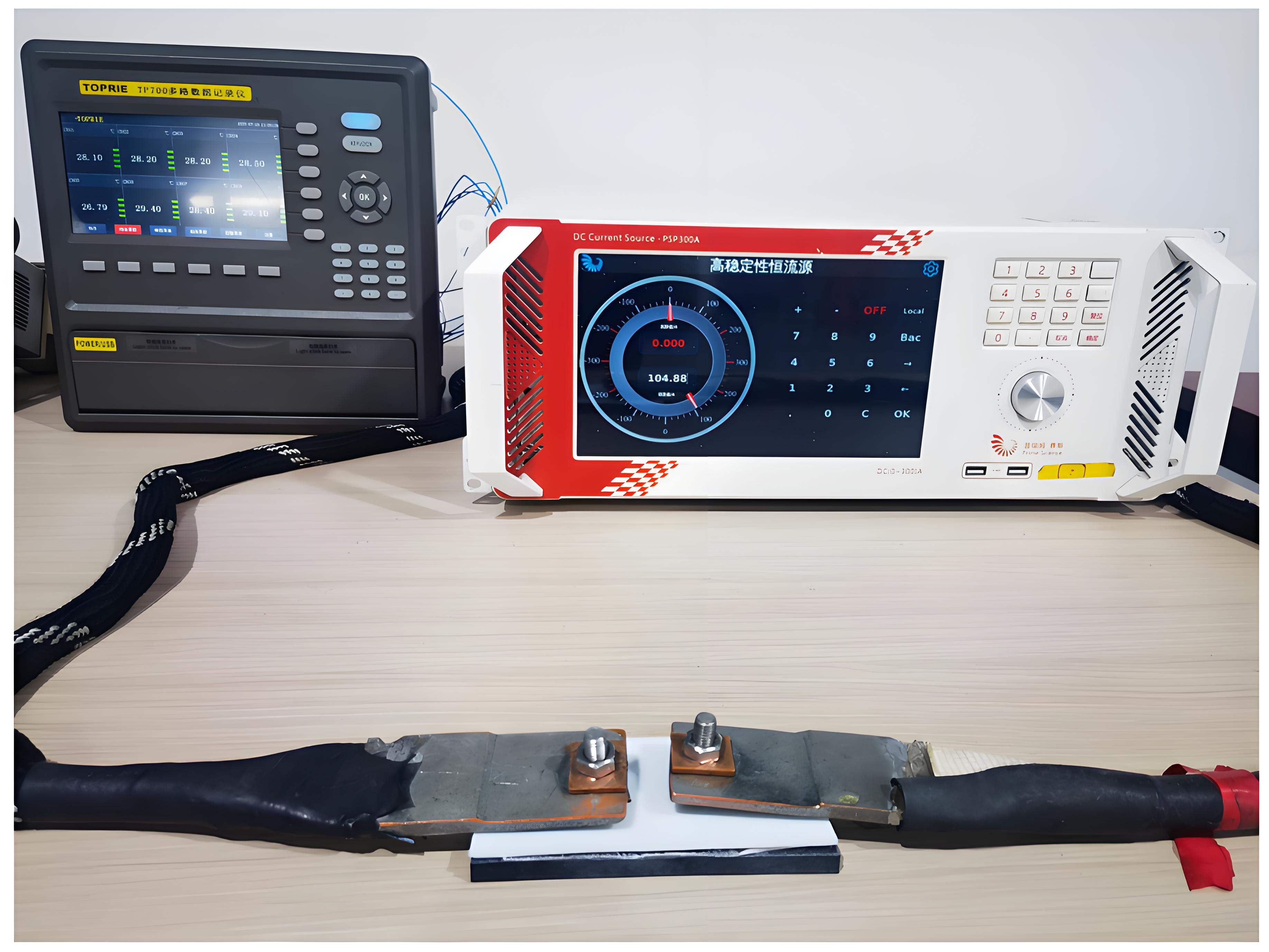
According to Ohm's law I=V/R, the current is calculated by measuring the voltage drop across a known resistor. As shown in the following diagram, when current flows through a resistor, a voltage difference will be generated across the resistor. Dividing this voltage value by the resistance value is the current value passing through the resistor. This method is usually called the shunt resistor method.
It is necessary to weigh the power consumption of the resistor (P=I*I*R) and the voltage drop. If the resistance value is increased to obtain a larger voltage difference, there will be a problem of excessive heating of the resistor. Therefore, a resistor with the smallest possible resistance should be used for detection. When the voltage difference is too small, an amplifier circuit is required to amplify the detection voltage.

In addition to the shunt resistor method, there are usually other methods such as the Hall effect method, the magnetoresistance effect method, and the current transformer to detect current. Generally speaking, the shunt resistor method has a simple principle, low cost, and is less affected by circuit and environmental factors. For example, Hall detection generally requires temperature drift correction, magnetoresistance effect method is usually only applicable to high frequency or small current detection, and current transformer is only applicable to AC detection.
II. Application of current detection principle
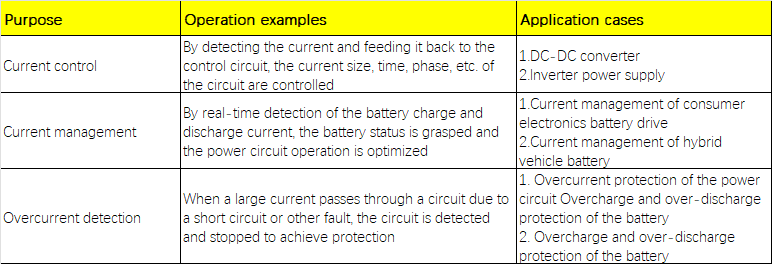
1. Overcurrent detection: When the circuit fails and overloads, causing the current to exceed the normal range, it is necessary to stop the circuit operation to ensure safety. When the current exceeds the set value, it is judged as abnormal and the output is cut off.
2. Current control: The peak value of the sawtooth current flowing through the reactor is detected by a DC-DC inverter for control. In addition, in order to drive the three-phase motor to rotate, the phase and time of the current need to be correctly controlled. Therefore, it is necessary to detect the current flowing through each phase and feed it back to the control circuit. It is commonly used in EPS (electric power steering) and air conditioning.
3. Current management (battery management): Equipment that uses rechargeable batteries to work by detecting the current and voltage flowing through the battery and controlling the optimal circuit operation, so as to grasp the remaining power and can be used for a long time.
III. Selection of resistors for current detection
Current detection generally selects the corresponding resistance value so that the voltage difference when the current flows is tens of millivolt(mV) to hundreds of millivolt(mV). Therefore, a small resistance value of less than a few resistance is selected for current detection. Different types of resistors are selected according to the current value to be detected. When detecting a large current of tens of ampere(A), it is necessary to select a very small resistance value of several milliohms. When detecting a small current, a larger resistance value of hundreds of milliohms(mΩ) to several ohms(Ω) is selected for detection. Low-resistance thick film resistors, thin film resistors, metal film resistors, alloy resistors, etc. can be selected. At present, thin film resistors and precision alloy resistors are usually selected in the industry.
As a manufacturer of professional alloy resistors/shunts, milliohm electronic resistors can widely meet and solve current detection related products.
In control systems, low-resistance and high-precision sealed alloy series resistor products can more accurately detect the required current; in power management, milliohm resistors' exposed alloy resistor series products can accurately detect the required current; large current and high-power alloy shunts, small and high-power exposed alloy series resistors, sealed alloy series for small current purposes, etc., have a rich display of products according to different uses. At the same time, it can support customized precision resistors with high precision of up to 0.01%, low resistance of up to 1uΩ, temperature coefficient of up to ±1ppm/℃, and various packaging forms.
Application of Alloy Resistors in Automotive Battery Management System (BMS)
Six-terminal alloy resistor, high precision and high power dual-track approach
Related Article
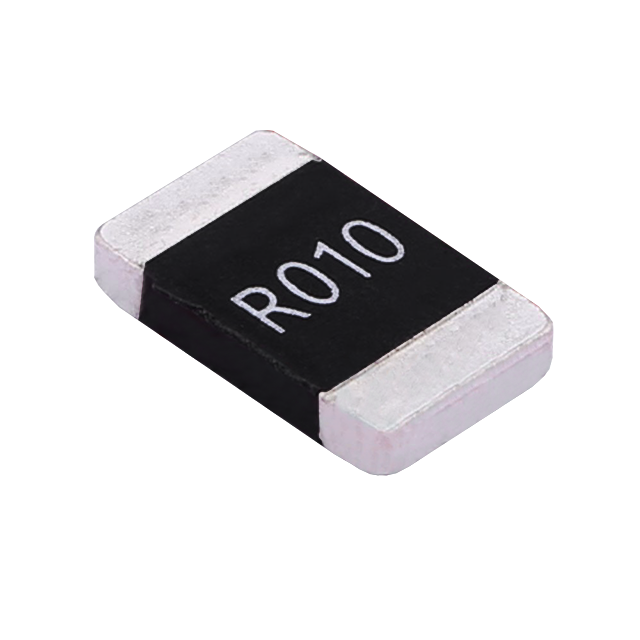
Key performance features: high power handling, ultra-low temperature drift, high overload withstand capability, low inductance at high frequency, and automotive-grade high reliability.
HoCG4527 Automotive Grade Molded Alloy Resistor
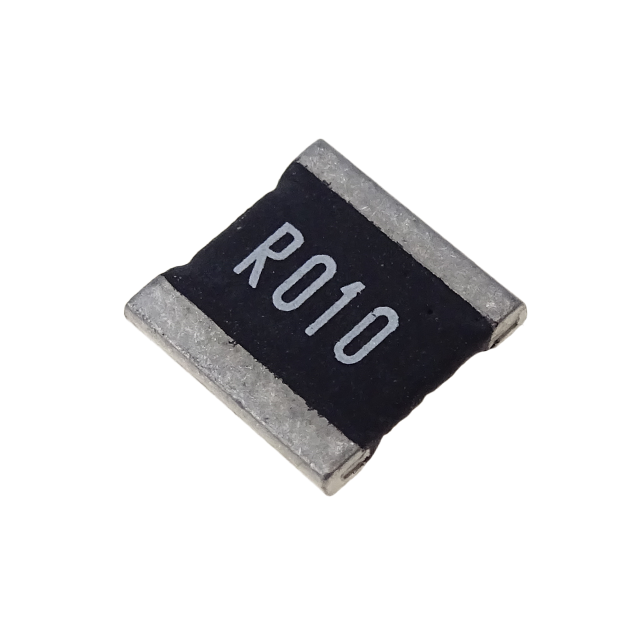
Key features: ultra-high current-carrying capability, ultra-high stability, ultra-low temperature drift, and low inductance at high frequency.
HoCG2728 Automotive Grade Molded Alloy Resistor

Alloy resistors, with their unique technical advantages—ultra-low resistance, low temperature drift, high power handling, low parasitic parameters, and strong pulse withstand capability—have become core components in current sensing, overload protection, and load matching circuits for EV charging stations.
Alloy Resistor Applications in New Energy