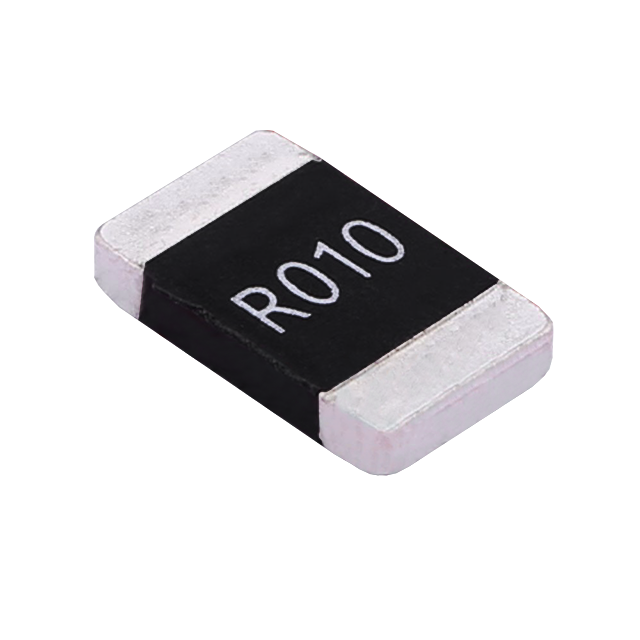
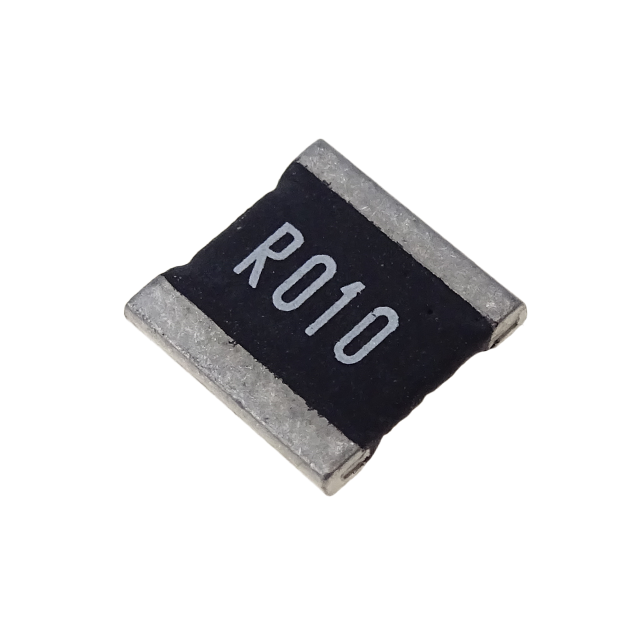
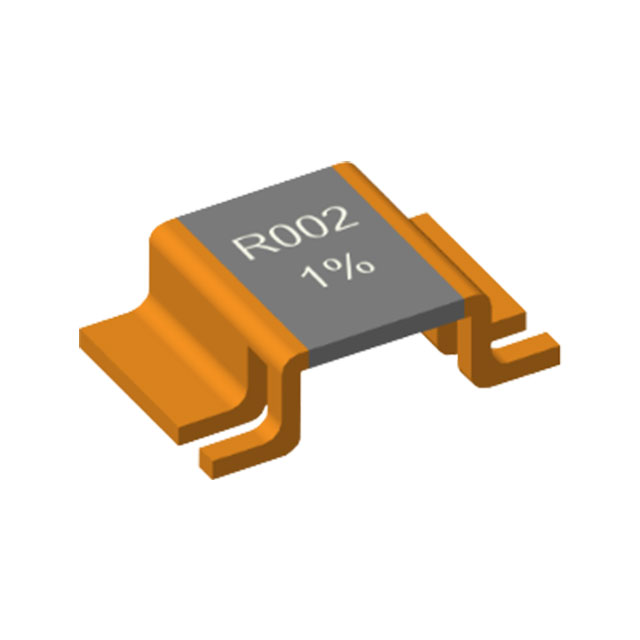
Anti-Sulfurated Resistor (HoAS Series)
I. Core Principle and Structure of Anti-Sulfuration Resistors
① Anti-Sulfuration Principle
Conventional chip resistors typically employ silver (Ag) as the electrode material. In sulfur-containing environments, silver readily reacts with sulfides (such as H₂S) to form silver sulfide (Ag₂S). This chemical reaction causes a sharp increase in electrode resistance and poor contact, ultimately leading to resistor failure.
The HoAS series anti-sulfuration resistors incorporate a specialized structural design and material selection to form an effective protective barrier on the electrode surface. This barrier prevents sulfides from coming into contact with the internal electrodes, fundamentally eliminating the occurrence of sulfuration reactions. As a result, the resistor maintains stable electrical performance over extended periods in sulfur-containing environments.
② Product Structure
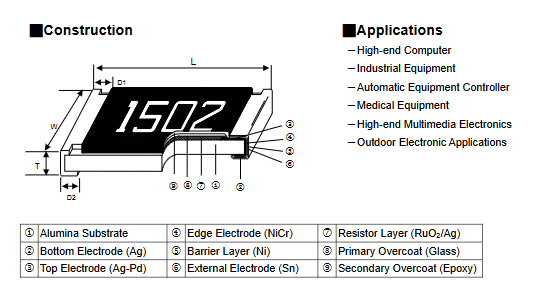
The HoAS series anti-sulfuration resistors adopt a rectangular chip-type fixed structure, consisting of nine core components in total. The functions and materials of each part are shown in the table below. The structural design balances anti-sulfuration performance with electrical stability.
| No. | Composition Name | Material | Core Function |
| 1 | Alumina Substrate | Alumina (Al₂O₃) | Provides stable support and ensures heat dissipation performance |
| 2 | Bottom Electrode | Silver (Ag) | Enables current conduction and achieves strong bonding with the substrate |
| 3 | Top Electrode | Silver-Palladium (Ag-Pd) | Enhances electrode corrosion resistance and strengthens anti-sulfuration capability |
| 4 | Edge Electrode | Nickel-Chromium (NiCr) | Assists current conduction and optimizes electrode contact performance |
| 5 | Barrier Layer | Nickel (Ni) | Isolates sulfides and protects internal electrodes from corrosion |
| 6 | Outer Electrode | Tin (Sn) | Facilitates soldering and improves bonding strength with the PCB |
| 7 | Resistor Layer | Ruthenium Oxide/Silver (RuO₂/Ag) | Serves as the core resistive element, determining resistance value and precision |
| 8 | Primary Coating | Glass | Protects the resistor layer and enhances insulation performance |
| 9 | Secondary Coating | Epoxy Resin | Provides outer-layer protection, enhancing anti-sulfuration and moisture resistance |
II. Key Technical Specifications
① Dimensional Parameters
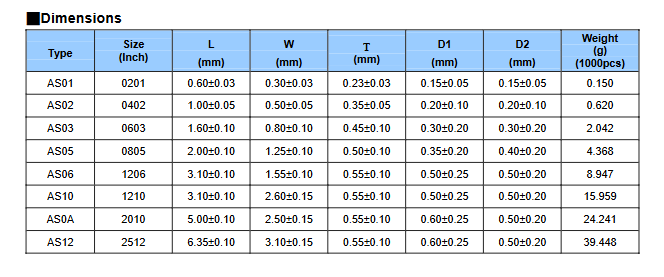
The HoAS series anti-sulfuration resistors are available in a wide range of package sizes, covering the full spectrum from 0201 to 2512, to meet diverse circuit design requirements. The core dimensional parameters (unit: mm) and weight per 1,000 pieces are presented in the table below (tolerances are indicated within the table).
② Core Electrical Specifications
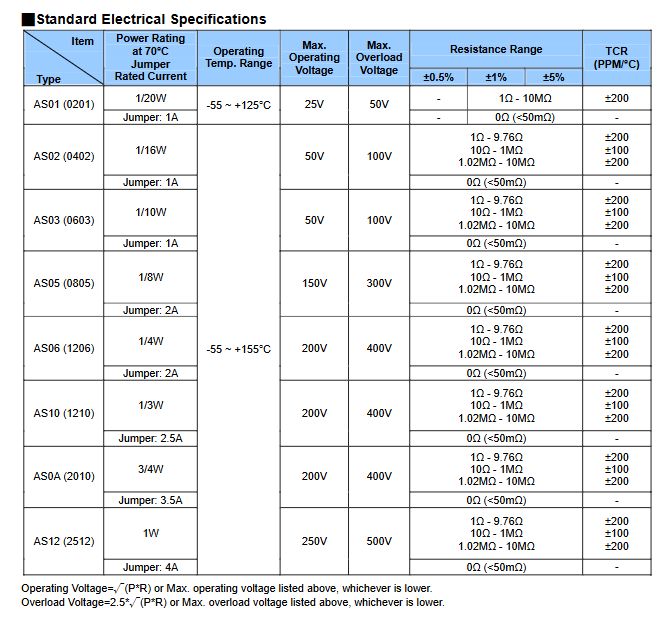
The rated parameters, operating ranges, and precision of this resistor series at an ambient temperature of 70°C are provided below. All parameters comply with industry standards and product specification requirements, ensuring product reliability.
③ Environmental & Reliability Parameters
The HoAS series anti-sulfuration resistors have passed a comprehensive suite of reliability tests. Key environmental characteristics are outlined below, ensuring long-term stable operation in harsh conditions:
-
Sulfuration Test: Performed per ASTM-B-809-95 standard at 50±2°C, 91~93% RH in H₂S-containing atmosphere, with no power load, for 1,000 hours. Resistance change ≤ ±0.5% (including jumpers).
-
Temperature Resistance: Dry heat test at +125/+155°C for 1,000 hours: resistance change ≤ ±1.5%. Temperature cycling from -55°C to +125/+155°C for 5 cycles: resistance change ≤ ±1.0%.
-
Humidity Resistance: Tested at 40±2°C, 90~95% RH under load for 1,000 hours: resistance change ≤ ±3.0%.
-
Solderability: After 3 seconds at 245±5°C, solder coverage ≥ 95%. After 10 seconds at 260±5°C, resistance change ≤ ±1.0%.
-
Insulation Resistance: ≥ 10 GΩ, with no breakdown or arcing.
-
Short-Time Overload: Tested at 2.5× rated operating voltage for 5 seconds (2 seconds for high-power series): resistance change ≤ ±2.0%.
III.Application Scenarios & Selection Guidelines
① Application Scenarios
Leveraging its exceptional anti-sulfuration performance and stable electrical parameters, the HoAS series anti-sulfuration resistors are widely used in various electronic devices operating in sulfur-containing and harsh environments, including but not limited to:
-
Industrial Equipment: Industrial controllers, frequency inverters, sensors, etc., resisting sulfide corrosion in industrial atmospheres.
-
Outdoor Electronic Equipment: Outdoor monitoring devices, communication base stations, photovoltaic inverters, etc., adapting to humid and sulfur-containing outdoor conditions.
-
High-End Electronic Equipment: High-end computers, multimedia devices, medical equipment, etc., ensuring long-term stable operation.
-
Automation Equipment: Automatic control equipment, servo systems, etc., meeting high-reliability and long-life requirements.
② Selection Guidelines
Selection should take into account circuit requirements, environmental conditions, and product parameters. The core considerations are as follows:
-
Package Selection: Choose the appropriate package size based on PCB space and power requirements. Larger packages offer higher rated power and stronger anti-sulfuration capability.
-
Resistance Value & Tolerance Selection: Select the appropriate resistance range and tolerance (±0.5%, ±1%, ±5%) according to circuit design requirements. For the 0603 package with 1% tolerance, E96 series coding is used; for other tolerances, E24 series coding applies.
-
Power & Voltage Selection: Ensure that the rated power and maximum working voltage of the selected resistor meet the actual circuit power and voltage requirements. A 50% derating margin is recommended to enhance reliability.
-
Environmental Adaptability: In harsh environments involving sulfur, humidity, extreme temperatures, etc., priority should be given to this series of anti-sulfuration resistors to avoid failures caused by sulfuration that may occur with standard resistors.
-
Soldering & Mounting: Follow the recommended soldering conditions (reflow soldering, wave soldering) based on the assembly process to ensure solder joint quality and prevent resistor damage due to excessive soldering temperatures.
IV. Conclusion
The HoAS series anti-sulfuration resistors, featuring a specialized structural design and stringent quality control, deliver outstanding anti-sulfuration performance, stable electrical parameters, and high reliability. They effectively address the failure issues of conventional resistors in sulfur-containing environments, providing a robust guarantee for the long-term stable operation of electronic equipment.
This technical document presents only core technical information. For detailed parameters and test methods, please refer to the product datasheet. For any selection or application inquiries, please contact the manufacturer for professional support.
Core Discrepancies Between Exposed Alloy Resistors and Encapsulated Alloy Resistors
HoYLR2512 — Newly Launched High-Stability Anti-Sulfurated Encapsulated Alloy Resistor
Related Article