Analysis of Gold Aluminum Housing Resistor Products
A Gold Aluminum Housing Resistor is a power-type resistor featuring a high-resistivity alloy core and an aluminum alloy housing. It is manufactured through precision processes and special surface treatment (gold plating). Its core function is to address issues such as energy absorption, power distribution, load testing, and current/voltage limiting in high-power circuits, ensuring the stable operation of circuit systems under high-load conditions.
It is important to note that "Gold" does not refer to the housing material being gold, but rather to the special gold plating (or anodized gold plating process) applied to the housing. This treatment not only enhances product appearance for easy identification but, more critically, improves oxidation resistance and corrosion resistance, thereby extending the product's service life. It also reduces contact resistance and enhances the reliability of electrical connections.
II. Core Positioning and Advantages
Compared to traditional carbon film resistors and cement resistors, the core advantages of the Gold Aluminum Housing Resistor are concentrated in two dimensions: "High-Power Handling" and "High Stability." These can be summarized as follows:
① Heat Dissipation Advantage: The combined design of the aluminum alloy housing and heat dissipation base offers significantly higher thermal conductivity than ceramic or cement encapsulation. It rapidly dissipates heat generated during high-power operation, preventing performance degradation or damage caused by heat buildup. Some products further enhance heat dissipation efficiency through housing groove design and optimized heat-dissipating coatings.
② Power Advantage: The power rating covers a range from 5W to 500W, with custom models reaching up to 1000W. This meets the design requirements of various high-power circuits, offering strong overload capacity and the ability to withstand short-term high-power surges.
③ Stability Advantage: Constructed with high-quality alloy resistance wire and precision manufacturing processes, the resistance value remains stable over the long term with minimal temperature drift. It also exhibits excellent vibration resistance and anti-interference capabilities, making it suitable for harsh industrial operating conditions.
III.Structural Analysis
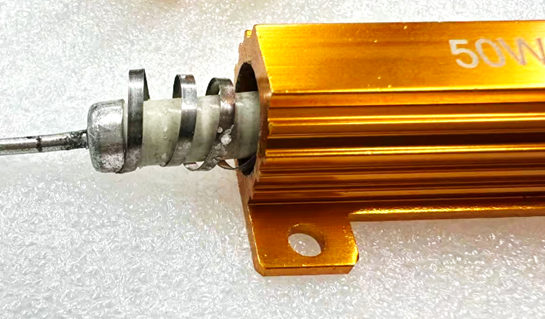
The structural design of the Gold Aluminum Housing Resistor revolves around three core objectives: "Heat Dissipation, Stability, and Reliability." It is composed of five main components, which work together to ensure the product meets performance standards. A schematic diagram of its structure is as follows (described textually to clearly show the position and function of each component):
Structural Breakdown Diagram: Aluminum Housing (Outer Layer) → Filling Material (Middle Layer) → Resistor Element (Core) → Heat Dissipation Base (Bottom/Side) → Terminals/Pins (Both Ends). Some custom models add silicone rubber plugs and wiring terminals to improve installation convenience and insulation performance.
IV. Detailed Explanation of Key Parameters
The performance of a Gold Aluminum Housing Resistor is closely related to ambient temperature and power load. The following analyzes its performance variation pattern based on two core curves, providing a reference for selection and application:
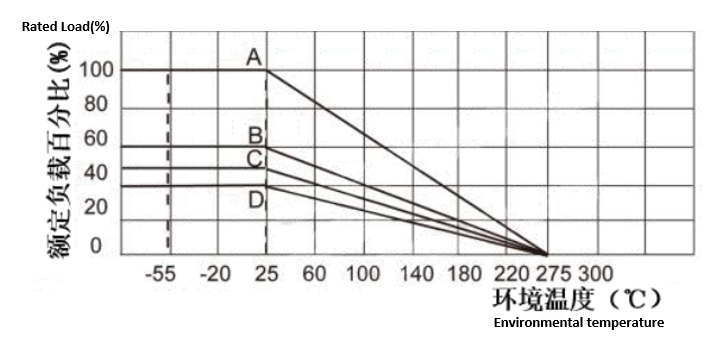
① Ambient Temperature - Power Rating Curve
① -1: Curve Characteristics: Shows a clear inverse relationship. The higher the ambient temperature, the lower the allowable power rating of the resistor. The curve shows linear decay as temperature increases.
① -2: Key Interpretation: When the ambient temperature reaches 125°C, the actual operating power of the resistor is only 50% of its rated power. When the temperature exceeds 200°C, the power derates to below 20% of the rated value. Therefore, when selecting resistors for high-temperature environments (e.g., near industrial furnaces, vehicle engine compartments), power derating design must be strictly implemented. It is recommended to reserve a power margin of 1.5 to 2 times to prevent damage from overheating.
② Power - Temperature Rise Curve
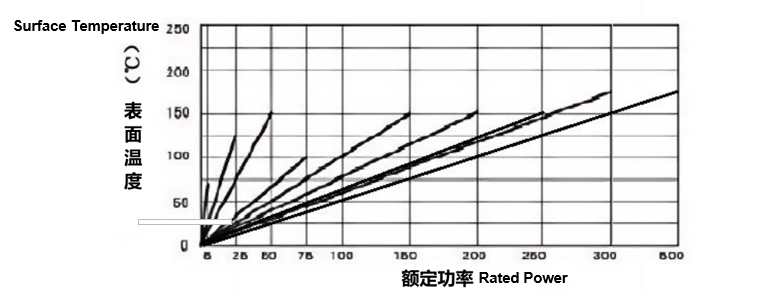
②-1: Curve Characteristics: The power rating is directly proportional to the resistor's surface temperature. The higher the power, the higher the surface temperature. The growth rate of the curve gradually slows down as power increases (limited by heat dissipation performance).
②-2: Key Interpretation: When the power rating reaches 500W, the resistor's surface temperature can reach approximately 250°C. At this point, an efficient heat dissipation plate must be used; otherwise, it will lead to performance degradation and shortened lifespan. When the power is below 50W, the surface temperature can be controlled within 100°C, requiring no additional heat dissipation measures.
②-3: Curve Description: The horizontal axis represents the power rating (W), ranging from 0 to 500W. The vertical axis represents the surface temperature (°C), ranging from 0 to 250°C. The curve starts from the origin and rises gradually as power increases: at 50W, the temperature is approximately 80°C; at 100W, approximately 120°C; and at 500W, it reaches 250°C.
V. Application Scenario Analysis
Leveraging its high power, high stability, and excellent heat dissipation performance, the Gold Aluminum Housing Resistor is widely used in various fields such as industrial electronics, new energy, and power equipment. Its core application scenarios focus on "high power, high precision, and harsh operating conditions." Specific details are as follows (illustrated with textual descriptions of application diagrams, clearly showing the scenarios and functions).
① Description of Typical Application Scenarios
Taking the bleeder system of a New Energy Vehicle as an example, the Gold Aluminum Housing Resistor acts as the core discharging component. When the power battery is fully charged or the system shuts down, it needs to quickly dissipate the excess charge within the battery pack to prevent safety hazards caused by charge accumulation. In this scenario, a Gold Aluminum Housing Resistor with high power, high-temperature resistance, and vibration resistance must be selected. It must ensure stable operation in the vehicle environment ranging from -40°C to 150°C, while also possessing excellent heat dissipation performance to rapidly dissipate the heat generated during the discharge process, thus ensuring the safe and reliable operation of the vehicle system.
② Core Application Areas and Functions
| Application | Detail Scenarios | The funtion of resistor | Key Selection Criteria |
| Power Equipment | Switching Power Supply, UPS, DC Power Supply | Load Testing, Voltage Division, Current Limiting, Stabilizing Power Output, Protecting Power Modules | Select power rating based on power supply wattage, reserve 1.5 times power margin, pay attention to accuracy and temperature drift. |
| Welding Machine | DC Welding Machine, AC Welding Machine | Current Adjustment, Energy Distribution, Ensuring Stable Welding Current, Improving Weld Quality | High Power, Vibration Resistance, TCR ≤350ppm/°C, Withstanding Voltage Requirements. |
| Frequency Converter | Industrial Frequency Converter, Motor Frequency Converter | Energy Absorption, Buffering, Suppressing Voltage Surge During Start/Stop, Protecting Frequency Conversion Module | Customizable Non-Inductive Type, Suitable for High-Frequency Environments, Excellent Heat Dissipation Performance. |
| New Energy Vehicles | Power Battery Management System, Bleeder System, Power Conversion Module, ADAS System | Dissipating Excess Power, Power Conversion, Current Detection, Ensuring Stable Operation of Onboard Systems | Automotive-Grade Standards, High Temperature Resistance, Vibration Resistance, Moisture Resistance, Sufficient Power Redundancy. |
| Other Fields | Photovoltaic Inverters, Wind Power Systems, Laboratory Test Equipment | Power Control, Load Simulation, Signal Regulation, Current Limiting | Select accuracy, power, and installation method based on specific scenarios; choose non-inductive types for high-frequency applications. |

Selecting a Gold Aluminum Housing Resistor requires considering factors such as circuit requirements, environmental conditions, and installation space. It should follow the principles of "power matching, appropriate accuracy, and adequate heat dissipation." Additionally, suitable alternative products can be chosen based on cost and specific application needs.
① Determine Power Requirements: Calculate the required power based on the voltage (U) and current (I) in the circuit using the formula P = U × I. It is recommended to reserve a power margin of 1.5 times (i.e., actual selected power ≥ 1.5 × calculated power). In high-temperature or high-vibration environments, a 2x power margin is recommended to prevent damage from overheating. Also, distinguish between the power ratings for models with and without a heat sink; high-power models must be used with a heat sink.
② Select Appropriate Resistance Value and Accuracy: Determine the resistance value range according to the circuit design requirements, prioritizing standard resistance values. Choose the accuracy class based on the circuit's precision needs: select ±1% or higher accuracy for precision circuits (e.g., instruments, high-frequency circuits), and ±5% accuracy for general circuits to reduce costs. Resistance tolerance can be flexibly chosen between 0.5% and 10% depending on the scenario.
③ Consider Temperature Coefficient: Select the temperature coefficient based on the ambient temperature fluctuation range. For low temperature drift scenarios (e.g., precision instruments), choose 100ppm/°C or lower (for molded products). For general scenarios, 250~350ppm/°C is sufficient. 50ppm/°C is only suitable for very low resistance value products; ensure compatibility during selection.
④ Pay Attention to Installation Dimensions: Carefully check the equipment's installation space. Select the corresponding product dimensions based on the mounting method (through-hole, screw fixing) to ensure the resistor can be installed smoothly. Reserve adequate space for heat dissipation, avoiding close proximity to other components that could lead to heat buildup.
⑤ Evaluate Heat Dissipation Conditions: Based on the heat dissipation conditions of the actual application environment, refer to the "Ambient Temperature - Power Rating Curve" to determine the final power selection. If no additional heat dissipation measures are available, derate the power rating. In high-temperature environments, auxiliary cooling equipment such as heat sinks or cooling fans must be used.
⑥ Confirm Special Requirements: For high-frequency circuits, select customized non-inductive models to avoid inductive interference. In humid or corrosive environments, pay close attention to the product's moisture resistance and corrosion resistance. For automotive applications, choose automotive-grade products that meet high-temperature resistance and vibration resistance requirements.
VII.Explanation of Installation Methods
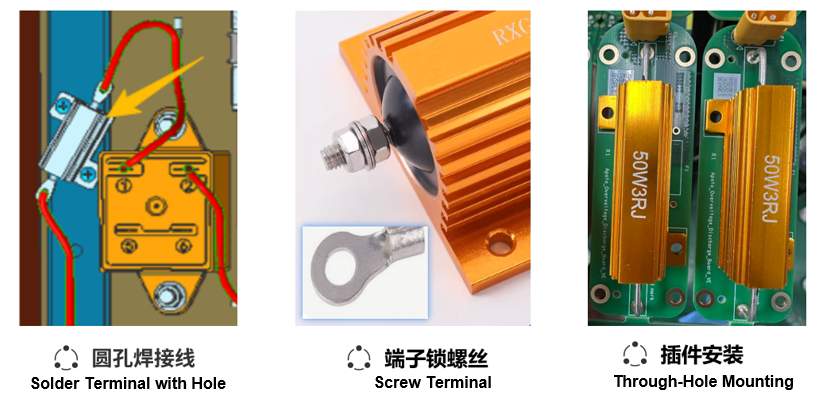
The Gold Aluminum Housing Resistor supports multiple installation methods to suit the mounting requirements of different equipment. The core installation methods are as follows:
① Soldering via Round Holes: Connection is made by soldering wires through the round holes in the terminals/pins. Suitable for scenarios requiring flexible wiring, providing a firm connection and reliable conductivity.
② Screw Terminals: Suitable for high-power models (100W and above). The resistor is fixed by securing terminals to wires and heat sinks with screws. This installation is firm, offers excellent heat dissipation, and is ideal for industrial equipment, high-power power supplies, and similar scenarios.
③ Through-Hole Mounting: Suitable for small power models (5W~50W). The pins are inserted into the circuit board and soldered. This method is convenient for installation and suitable for conventional electronic devices.
VIII. Conclusion
The Gold Aluminum Housing Resistor is a high-performance power resistor whose primary advantages lie in its superior heat dissipation capability, high power handling capacity, precision, and wide environmental adaptability. The structural design, featuring an aluminum alloy housing and a heat dissipation base, combined with precision manufacturing processes, ensures reliable operation under high-power and demanding conditions. The product series covers a power range of 5W to 500W and a resistance range of 0.01Ω to 82KΩ, with customization available for specialized requirements such as non-inductive or extended power versions. It is extensively utilized across various sectors, including industrial electronics, new energy systems, power equipment, and automotive electronics, establishing itself as an essential component in high-power circuitry.
When selecting a model for a specific application, careful consideration must be given to power rating, tolerance, temperature coefficient, mounting dimensions, and thermal management requirements. It is prudent to incorporate a suitable power derating factor based on the actual operating environment to guarantee optimal performance and longevity. Furthermore, depending on budgetary constraints and technical specifications, alternatives such as cement resistors or non-inductive resistors may be considered to achieve the desired balance between performance characteristics and cost-effectiveness.
If you would like to learn more about our products, solutions, or their application in specific scenarios, please feel free to contact our technical support team.
Comparison of Differences Between Milliohm Busbars and 0-Ohm Resistors
FL2 vs FL3T Shunt: Key Feature Differences
Related Article